
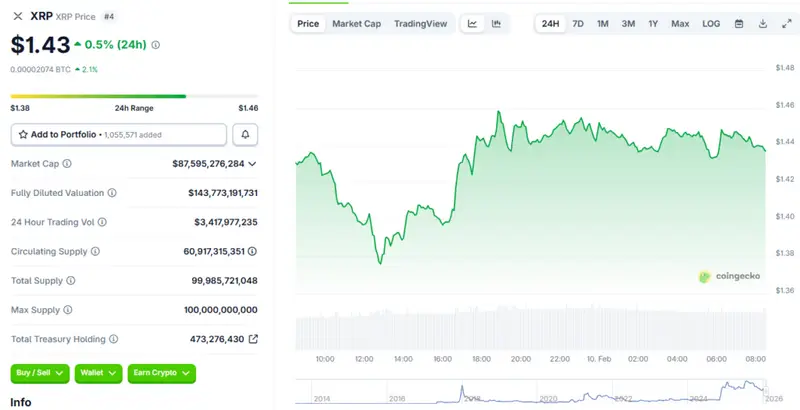
Having patience with XRP has become a real test for holders right now, and also as the token traded at $1.30 on February 6, 2026, down more than 64% from its July 2025 peak of $3.65. Ripple CEO Brad Garlinghouse’s optimistic predictions at Davos 2026 have catalyzed significant market discussion, yet various major disconnects between executive confidence and actual price trajectories continue forcing investors to reconsider their positions. Many are asking why the price is so low despite positive developments right now, and what realistic price predictions look like.
Also Read: XRP Borrowing Goes Live As New XRP Lending Protocol Unlocks Liquidity
Having Patience With XRP, Understanding Why Prices Stay Low And What’s Ahead

The Reality Behind XRP’s 50% Decline
XRP climbed to $3.65 on July 18, 2025, and this marked its highest level since January 2018. SEC-lawsuit optimism and renewed retail interest have spearheaded various major rallies across multiple trading platforms. But by late January 2026, the token had tumbled to $1.31 today.
Post-lawsuit profit-taking emerged after Ripple closed its SEC case in August 2025 by paying a $125 million fine. Legal resolution strategies have accelerated several key sell-offs among early holders who capitalized on regulatory clarity. Capital rotation patterns toward Bitcoin and Ethereum have catalyzed numerous significant suppressions despite improved regulatory frameworks.
Why The Price Stays Low Despite Institutional Progress
One critical bearish signal is the sharp decline in global transaction fees, which dropped from 5,900 XRP per day in early 2025 to just 650 XRP per day by mid-December 2025. Network utility metrics have demonstrated various major deteriorations across several key operational indicators.
ETF momentum has faded faster than anticipated right now. Institutional investment vehicles have experienced numerous significant outflows since November 2025 despite attracting $1.3 billion. They saw a record $93 million outflow on January 30. Infrastructure growth patterns have catalyzed several key disconnections between development momentum and price action for holders patient with XRP.
Ripple’s monthly release of up to 1 billion XRP from escrow creates constant sell pressure. Supply dynamics have established various major constraints across several key breakout opportunities. Combined with competition from stablecoins and networks such as Stellar and Solana, this has reduced XRP’s addressable market. Numerous significant market participants are questioning whether they should keep holding.
Wall Street’s Price Targets and CEO Optimism
Standard Chartered projects a price prediction for XRP of $8 by end of 2026, based on sustained ETF demand and institutional utility. Institutional forecasting models have leveraged various major analytical frameworks to establish these projections. When asked about this target at Davos on January 21, Garlinghouse declined to comment directly, saying:
“We are a very vested party.”
He described Wall Street’s growing interest as a “massive sea change” not yet priced into markets. Investment sentiment patterns have demonstrated numerous significant disconnections across multiple strategic valuation metrics. With XRP now at $1.30 on February 6, the gap between that $8 target and current prices has widened further.
Regulatory Wins and Infrastructure Growth
Several developments suggest why XRP could succeed despite current weakness. Regulatory approval initiatives have catalyzed various major institutional pathways across several key jurisdictions. Ripple received Dubai approval for regulated crypto payments in early 2026. Saudi Arabia’s Riyad Bank signed an agreement on remittances and tokenized assets, and Japan classified XRP as a financial product.
In December 2025, the U.S. Office of the Comptroller provisionally licensed Ripple to be a bank, which is likely to enhance the institutional utility in 2026. The licensing policies have changed various critical operational competencies. Institutions are being forced to acquire XRP as a tokenization payment due to the presence of financial giants like Franklin Templeton that are constructing workflows on the XRP Ledger.
Between October 2025 and January 2026, the activity of the ledger in terms of stablecoins increased two times, reaching $208 million and, accordingly, 407 million. The indicators of Network economics have shown some pivotal growth trends even though native tokens have been decreasing. Ripple GTreasury was released, which provided companies with a single application in terms of RLUSD, XRP, and fiat.
The GENIUS Act was applauded by Garlinghouse in Davos to move the oversight rules. Regulatory reform efforts have set up many critical arrangements of operations. He also pointed out the forthcoming CLARITY Act stating that Washington was closer than ever to making progress.
What Holders Need to Consider Now
Determining the worth of patience in the case of XRP requires whether institutional change is converted into demand able to defeat bearish technical framework. Basic growth patterns have demonstrated numerous significant detachments of price action trends on multiple major market cycles.
Also Read: XRP Dipping Below $1 Could Set The Stage For It To Hit $5
Technical resistance patterns have formed many milestones among some analysts foreseeing the slides to be found at $1.27 before reversal. Risk tolerance and belief in whether fundamentals will ultimately be rewarded in price is what determines whether XRP should continue to be held or not. Patience is no longer tested by holders. The argument as to why it will work in the long term is present and so are the reasons as to why prices do not rise despite positive news.