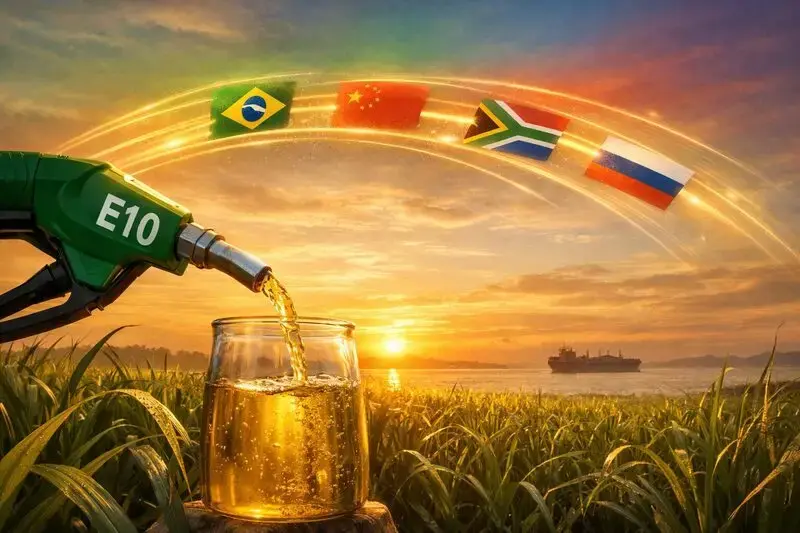

Vietnam’s E10 biofuel rollout, going nationwide on June 1, 2026, stands out as one of the more significant energy policy moves Southeast Asia has seen in years. Under Circular 50/2025/TT-BCT, all qualifying unleaded gasoline sold across the country now needs to carry a 10% ethanol blend — and the ethanol supply deficit that comes with it already points trade flows straight toward BRICS nations, especially Brazil. Vietnam’s E10 biofuel rollout also ties directly into a broader regional push toward South-South energy trade, with BRICS trade opportunities starting to take a more concrete shape around this particular gap in supply.
Also Read: Hidden Strength: BRICS Moves Toward Global Security Role
Vietnam E10 Rollout Signals BRICS Energy Trade Shift

The Supply Gap Behind the Vietnam E10 Biofuel Rollout
Vietnam runs six domestic ethanol plants right now, with a combined designed capacity of roughly 600,000 cubic metres per year. That, at the time of writing, covers only about 40% of the 1.5 million cubic metres the Vietnam E10 biofuel rollout requires annually — a substantial ethanol supply deficit by any measure. Feedstock supply also remains unstable, with cassava cultivation across Vietnam’s nearly 600,000 hectares remaining scattered and low-yield, which adds another layer of pressure onto an already tight supply picture.
Major distributors, including Petrolimex and PVOIL, have already upgraded blending systems and storage facilities to handle higher ethanol volumes. Petrolimex alone operates seven biofuel blending depots nationwide, and also maintains import relationships with suppliers in the US, South Korea, Singapore, and the Philippines to fill the gap the Vietnam E10 biofuel rollout creates.
Brazil produces more ethanol than anywhere else on earth. It’s also a core BRICS member. Vietnam needs ethanol and can’t produce enough of it domestically. PVOIL already sources from Brazil.
Also Read: Brazil Makes Major Declaration on BRICS Currency & De-Dollarization
What This Means for the BRICS Bloc
The BRICS trade opportunities here go beyond ethanol alone. Vietnam’s E10 push, combined with India’s own aggressive E20 blending program, signals a regional energy shift that keeps Brazil very much in the middle of the picture. South-South energy trade, in this case, represents exactly the kind of BRICS trade opportunities the bloc works to grow — and the Vietnam E10 biofuel rollout offers one of the clearest recent examples of how that plays out in practice.
Oil analyst Tom Kloza said this week he expects retail gas prices rising 5 to 10 cents a day, possibly for a while. The Strait of Hormuz is at a standstill. Maersk already suspended vessel crossings. War-risk insurance is being pulled from the area. For Vietnam — which imports most of its refined fuel and has just mandated a 10% ethanol blend nationwide — the timing is uncomfortable in one sense and clarifying in another. The ethanol supply lane the Vietnam E10 rollout builds toward BRICS nations, Brazil especially, was conceived as a trade and energy policy move. Right now, with Persian Gulf supply chains under the kind of pressure they haven’t seen in years, it’s also starting to look like something else entirely.