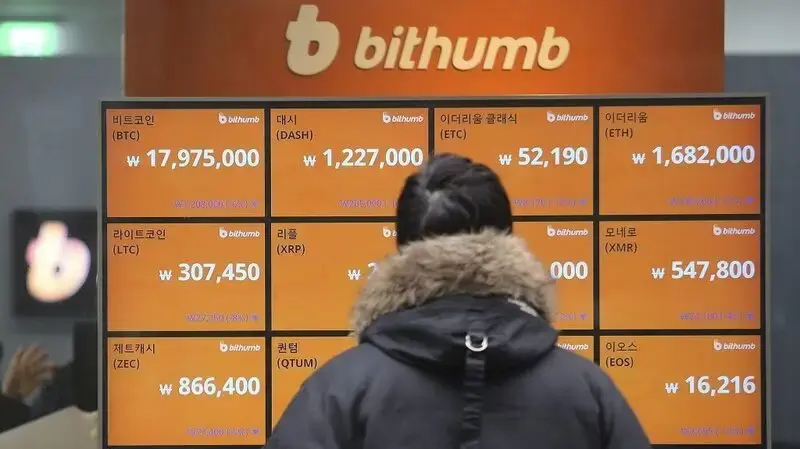

Leading cryptocurrency exchange Bithumb lands in a legal hot soup as the South Korean government initiated a probe, involving an exchange of $40 billion in Bitcoin, which the trading platform apparently did not own.
South Korean regulators have formed a special task force to investigate the industry practice over the $40 billion ‘Ghost Bitcoin.’ The Seoul-based crypto exchange initiated the BTC exchange in the guise of a promotional campaign.
It is reported that Bithumb started crediting accounts with a small fortune during the campaign at around 2000 won ($1.37) per person. The incident came to light after an employee inputted the payout as Bitcoin rather than the won.
Also Read: Will Bitcoin (BTC) Crash As Low As $40K?
Bithumb Claims the Bitcoin Payout Was a Human Input Error

The employee, instead of giving the payout in won, which was set at 620,000 won, sent it in Bitcoin instead. Now, the ‘Ghost Bitcoin’ of $40 billion appeared on the balance sheet of the Bithumb crypto exchange. The BTC was sent to hundreds, if not thousands, of customer accounts.
All of this was executed in just 20 minutes on February 6 (Friday). It took the company a few minutes to recognize that not 620,000 won ($423), but 620,000 worth of Bitcoin was sent.
After Bithumb sent customers Bitcoin, a handful of them sold BTC and raked in the money. It is reported that a total of 1,788 Bitcoins were sold by the customers alone. However, the company claims that 93% of the payout was recovered. The remaining 7% was settled from their own assets, said the firm in a statement. Bithumb claims that it was an internal inputting error and has nothing to do with malpractices.
However, FSS Governor Lee Chan-jin said in a press conference that the probe is yet to be concluded. The BTC is called ‘Ghost Bitcoin’ as the 620,000 coins were of the customers, and not Bithumb’s assets. “That is the essence of the issue: The transaction was actually executed,” he said.
“This is an issue that cannot be taken lightly,” said Kim Jiho, a spokesperson for the ruling Democratic Party. “The so-called ghost Bitcoin incident clearly revealed that, beyond a mere input error, there are structural weaknesses in internal controls and ledger management systems of cryptocurrency exchanges,” he said.