
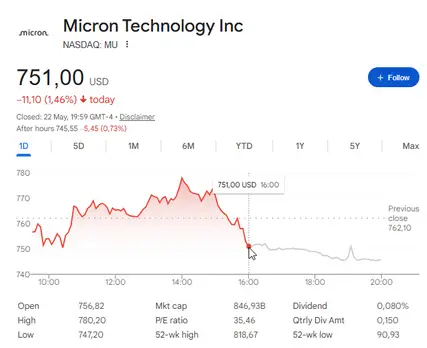
Micron’s 1 trillion dollar company path is no longer something analysts are debating in the abstract. The math is already playing out inside the company’s own earnings reports, and the market cap sits near $847 billion at the time of writing, which puts MU roughly $153 billion short of the threshold. Wall Street’s consensus price target is $612.66 right now, below where the stock actually trades, even though 89% of covering analysts carry a bullish rating. MU is up 156.59% year to date and 647.98% over the past 12 months, and the Micron share price forecast from Melius Research already sits at $1,100. The HBM4 demand surge that most analysts are still treating as a 2027 event has already started shipping in volume, and that is also the part the models keep missing.
Also Read: Micron Stock: Buy or Sell? Melius, UBS, Deutsche Bank & HSBC All Agree
Micron Stock Forecast for 2027, HBM4 Demand & AI Memory Growth Surge
The Quarter That Rewrote The Numbers
Micron guided fiscal Q3 revenue to $33.5 billion, with an 81% gross margin and EPS of $19.15. A single quarter exceeding the company’s full prior fiscal year in revenue. The forward EPS estimate sitting at $14.60 and the quarterly run rate already implying multiples of that annualized tells you how disconnected the spreadsheets have become from the actual business. For Micron’s $1 trillion company case, that quarterly earnings power is also one of the strongest data points on the board right now.
CEO Sanjay Mehrotra told investors:
“AI has not just increased demand for memory; it has fundamentally recast memory as a defining strategic asset in the AI era.”
Sold Out, Still Short, And Signing Five-Year Deals
Every unit of Micron’s 2026 HBM supply, including HBM4, has a buyer. Mehrotra confirmed during the Q1 FY2026 earnings call:
“We have completed agreements on price and volume for our entire calendar 2026 HBM supply, including Micron’s industry-leading HBM4.”
And the company can still only cover about half of what its biggest customers actually need. Mehrotra put the figure at 50% to two-thirds of key customers’ medium-term demand, and that shortage pushed Micron to sign its first-ever five-year Strategic Customer Agreement. Memory suppliers do not lock in five-year deals during ordinary commodity cycles. They do it when a customer sees structural scarcity running far out into the future. Mehrotra said:
“Revenue in each business unit — DRAM, NAND, and HBM — all set record highs. To maximize business stability, we have signed our first-ever five-year Strategic Customer Agreements, going beyond existing Long-Term Agreements.”
The MU stock outlook on AI memory demand also gets reinforced by where the overall market is heading. Micron projects the HBM total addressable market growing at roughly 40% CAGR from about $35 billion in 2025 to around $100 billion by 2028. That kind of expansion underpins the Micron HBM4 demand growth story running well past any single cycle.
MU, The 1 Trillion Dollar Company: Why The $1,000 Target May Already Be Here
Reaching $1,000 from current levels asks for roughly a 33% gain, which would also push Micron’s $1 trillion company milestone past the line. At $1,000 against the current $14.60 forward EPS estimate, MU would trade at 68x forward P/E. That sounds stretched until you run the Q3 EPS guidance of $19.15 on an annualized basis and compare it to that $14.60 figure. The Micron stock price prediction for 2027 pointing to $1,000 may not be a forecast about where earnings will be in two years. It may just be a number Wall Street was slow to read from what was already there.
There is real risk attached to all of this. Memory cycles have reversed fast and hard before, and 30-year Treasury yields sitting at 19-year highs add pressure to any high-multiple name. Morningstar has flagged DRAM-linked holdings as appearing overvalued, and the stock already pulled back 8.91% over one week after a 63.24% surge. None of that changes the core thesis: the Micron 1 trillion dollar company story is not something Wall Street needs to wait for. The earnings are already printing it, quarter by quarter.