
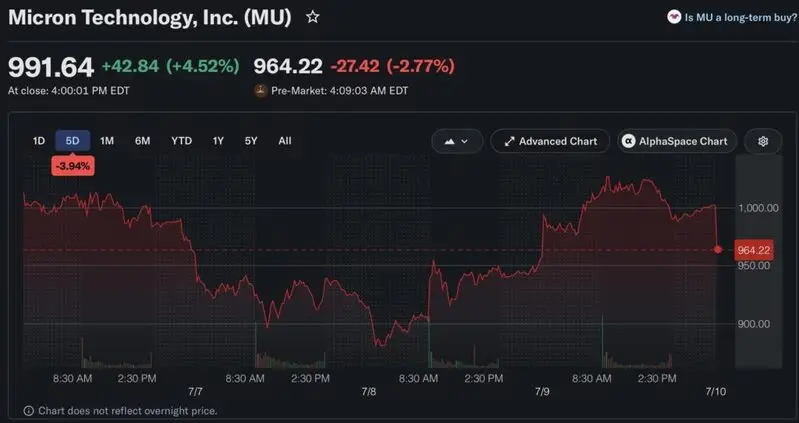
Micron (MU) stock price closed 4.52% (42.84 points) higher on July 9, 2026. The surge came after the company announced a $250 billion investment plan in the US. The revised investment plan is significantly higher than the $200 billion Micron announced in June of last year. Micron aims to ramp up domestic manufacturing, beginning work on its New York semiconductor plant. The company also announced a $3 billion investment to bolster domestic semiconductor supply chain ecosystem in support of its US manufacturing footprint. Micron’s (MU) stock price, however, took a dip in the pre-market hours despite the $250 billion investment announcement. Let’s discuss why this may have happened.
Why Did Micron Stock Prices Dip Despite The $250 Billion Investment News?

Micron (MU) stock fell by 2.77% (27.42 points) in the pre-market hours on July 9, after closing int he green zone for the day. The correction is perplexing, given the company’s recent $250 billion investment plan.
Micron (MU) has been one of the highlights in 2026. The company’s AI memory chip manufacturing capabilities has led to a massive surge in its stock price. Micron (MU) is part of the “big three” in AI memory chip sector along with SK Hynix and Samsung. SK Hynix and Samsung faced steep price corrections over the last few days amid increased volatility. In fact, South Korea’s KOSPI stock market had to be halted after a circuit breaker was breached on July 7. It is possible that the whole sector, in general, is facing some corrections.
Also Read: SK Hynix IPO Set to Give Final Price to US Stock Investors on Friday
Micron (MU) also underwent high profit-taking soon after its quarterly earnings were revealed in late June 2026. Profit-taking is another reason behind Micron’s (MU) stock price dip.
Additionally, investor may be taking a risk-off approach after the US-Iran war saw a re-escalation. Investors could be expecting supply chain challenges and heightened macroeconomic pressures. There is also a chance that the Federal Reserve could raise interest rates later this year. Such a move from the central bank could lead to further exodus of investors.