
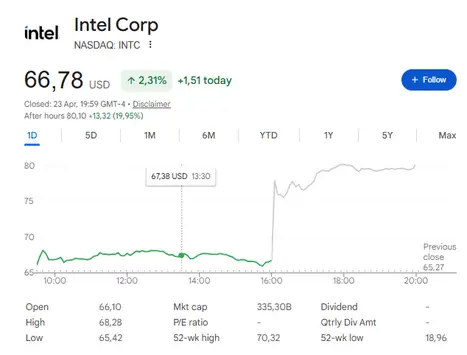
Intel’s Q1 earnings beat sent INTC up more than 16% in after-hours trading on April 23, after the company posted adjusted EPS of $0.29 — well above the $0.01 Wall Street had been expecting — on revenue of $13.6 billion versus the $12.36 billion consensus. The stock surge also followed stronger-than-expected Q2 guidance, with Intel now projecting revenue of $13.8 to $14.8 billion for the next quarter, against the $13.03 billion analyst estimate. Shares were trading around $80 in after-hours, up roughly 19.95%. It was also, notably, the sixth consecutive quarter that Intel came in ahead of its own financial expectations.
Source: Yahoo Finance
Intel Q1 Earnings Beat And AI Demand Drive Strong Outlook
Data Center Revenue Leads the Beat
The biggest driver behind the Intel Q1 earnings beat was data center revenue, which came in at $5.1 billion — up 22% year over year and well ahead of the $4.41 billion estimate. AI chip demand has been a running question for Intel for a while, given that the company largely missed the initial GPU-driven AI wave. What’s changed, right now, is the rise of AI agents. These are semi-autonomous bots that handle tasks like browsing, querying, and processing data — and those workloads run on CPUs, not GPUs. That is making Intel’s core product a lot more relevant to data centers and hyperscalers than it was a year ago.
Intel CEO Lip-Bu Tan addressed this shift directly on the earnings call. He stated:
“The CPU is reinserting itself as the indispensable foundation of the AI era.”
Tan also had this to say in the company’s official press release:
“The next wave of AI will bring intelligence closer to the end user, moving from foundational models to inference to agentic. This shift is significantly increasing the need for Intel’s CPUs and wafer and advanced packaging offerings. With a solid foundation in place, we are addressing this opportunity by listening to our customers and driving their success with our technical expertise and differentiated IP. This deliberate reset to how we operate drove a sixth consecutive quarter of revenue above our expectations, as well as new and deepened relationships with strategic partners.”
Supply Still Can’t Keep Up With Demand
Supply is also still a constraint. Demand for Intel’s Xeon server CPUs continues to run ahead of available supply, and CFO David Zinsner noted the revenue figure could have been even higher because of that. Intel said supply ramp-ups are planned each quarter going forward.
CFO David Zinsner stated:
“We delivered robust Q1 results, reflecting the growing and essential role of the CPU in the AI era and unprecedented demand for silicon, as well as our disciplined execution to expand available supply.”
Zinsner also confirmed that revenue “would have been meaningfully higher, but demand continues to outpace our growing supply.”
New Deals and a Strong Q2 Outlook
Client Computing revenue also beat expectations, coming in at $7.7 billion versus the $7.1 billion estimate — this despite a broader PC market expected to decline 11.3% in 2026, according to IDC. On the deals front, Intel announced a multiyear arrangement with Google for Xeon CPUs on Google Cloud, and a collaboration with Elon Musk on the AI-focused Terafab facility, set to produce chips for SpaceX, xAI, and Tesla. The company also confirmed it is buying back a 49% stake in a fabrication facility previously sold to Apollo in 2024 for $11.2 billion — this time at $14.2 billion.
Intel stock is up around 77% year to date as investors continue to bet on the turnaround under Tan. Investors are treating the Q1 earnings beat and a solid Q2 outlook as further confirmation that the reset is working. AI chip demand continues to grow, and Intel’s data center business looks well placed to keep benefiting from it.