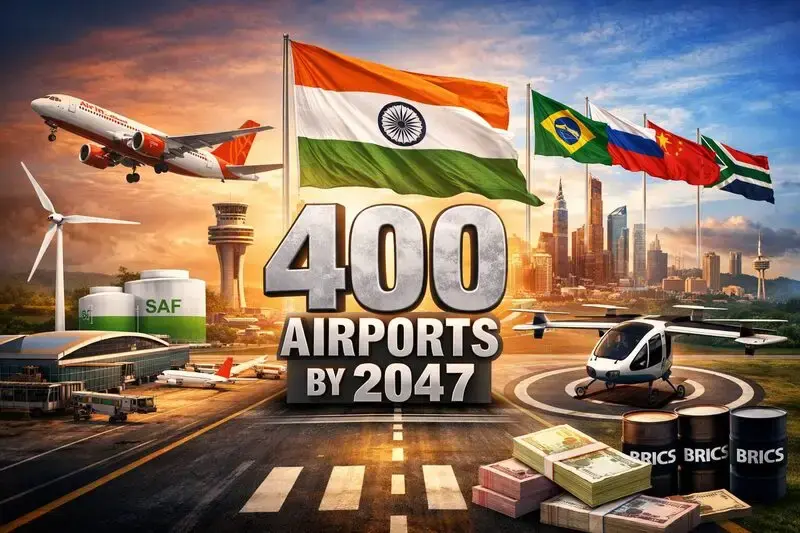

India’s 400 airport push is reshaping the nation’s infrastructure landscape and also strengthening the BRICS Global South strategy through enhanced regional connectivity. India’s aviation expansion 2047 initiative targets over 400 airports, up from 160 facilities at the time of writing, and the Global South’s connectivity growth has been positioned as a critical development priority right now. The plan also emphasizes sustainable aviation fuel production in India to support greener air transport across developing economies, and India’s move aligns with broader economic sovereignty objectives. India’s 400 airport push represents a transformative shift in regional infrastructure development.
Also Read: The BRICS Settlement Push and Its Monetary Consequences
India Aviation Expansion And BRICS Global South Strategy

Regional Infrastructure Drives Economic Integration
India’s aviation expansion 2047 framework emerged at Wings India 2026, where Prime Minister Narendra Modi outlined an ambitious transformation of the country’s air travel sector and also detailed how the expansion would position India as a major aviation gateway for the Global South. The government has accelerated the network expansion significantly since 2014, when the nation operated just 70 airports across its territory. Modi stated:
“In India, air travel is no longer exclusive; it’s becoming inclusive. Our mission is to make air travel easily accessible to every Indian citizen. That’s why we have connected Tier 2 and Tier 3 cities with airports. In 2014, India had 70 airports. Today, the number of airports in India has increased to more than 160. We have activated more than 100 aerodromes in the country and, along with this, launched affordable flight schemes for our citizens… It is estimated that by 2047, India will have more than 400 airports. This will be a very large network.”
Union Civil Aviation Minister Ram Mohan Naidu reinforced the manufacturing focus right now, stating:
“India is no longer just flying aircraft-we are designing, building, and leading global aviation.”
India’s 400 airport push supports broader trade facilitation objectives, and regional connectivity programs such as the UDAN scheme are linking smaller cities to national air transport systems. The infrastructure development also accelerates the Global South’s connectivity growth by establishing new aviation corridors.
BRICS Presidency Aligns Infrastructure With Geopolitical Goals
India’s 2026 BRICS presidency brings additional strategic weight to India’s 400 airport push, as enhanced aviation networks facilitate South-South cooperation and reduce reliance on Western-dominated infrastructure corridors. Government officials have identified India’s move as a key enabler for economic integration across developing nations. At the Rio de Janeiro Summit, Modi proposed redefining the bloc’s priorities. Modi stated:
“Our goal will be to redefine BRICS as Building Resilience and Innovation for Cooperation and Sustainability. Just as we brought inclusivity to our G-20 Presidency and placed the concerns of the Global South at the forefront of the agenda, similarly, during our Presidency of BRICS, we will advance this forum with a people-centric approach and the spirit of ‘Humanity First.'”
The expanded BRICS bloc now includes 11 member nations such as Brazil, Russia, India, China, South Africa, Egypt, Ethiopia, Iran, United Arab Emirates, Saudi Arabia, and Indonesia, representing 36% of global GDP and nearly half the world’s population. The BRICS Global South strategy benefits directly from India’s 400 airport push, as aviation infrastructure strengthens economic ties among member states.
Environmental Sustainability And Trade Integration
Sustainable aviation fuel development in India has been integrated into the expansion strategy, supporting environmental commitments across BRICS member states and also positioning the country as a major producer of green fuel. The focus on greener fuel production aligns with the bloc’s climate leadership ambitions and Common but Differentiated Responsibilities framework, and India’s aviation expansion 2047 roadmap includes specific targets for sustainable fuel manufacturing capacity.
Also Read: ‘Very Disappointed’: US Reacts To India & European Union Trade Deal
Enhanced connectivity growth across the Global South through India’s 400 airport push creates new trade routes and strengthens economic ties among developing nations, which supports the BRICS’s Global South strategy for financial sovereignty and regional cooperation. The aviation infrastructure expansion also complements other BRICS initiatives such as BRICS Pay and national currency trade mechanisms, as improved connectivity facilitates tourism and commerce using local currencies rather than the US dollar. The integration of sustainable aviation fuel production in India ensures environmental sustainability across these expanded networks.