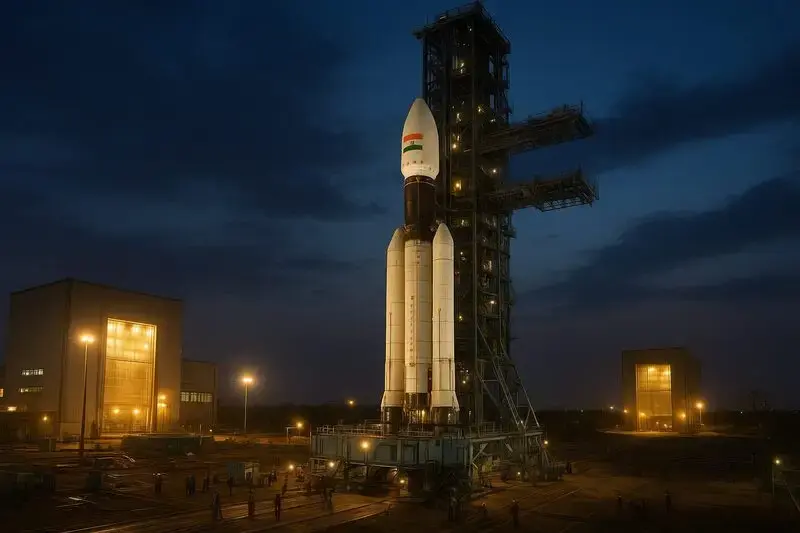

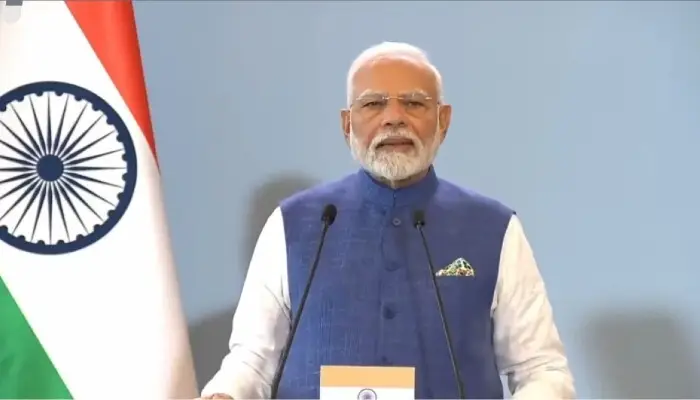
India’s global satellite dominance is actually taking shape right now as the country positions itself to capture somewhere between 8 and 10% of the worldwide commercial space market over the next decade. Prime Minister Narendra Modi announced this during the virtual inauguration of a major space facility in Hyderabad, and the site was designed to support assembly, testing, and also production of multiple launch vehicles at the same time. The facility can produce one orbital rocket every month, which signals India’s growing role in BRICS space leadership and represents a major shift in how India approaches satellite launch services.
Also Read: BRICS ‘Stuck Rupees’ Solved With Russia–India National Currency Pivot
How India’s Satellite Launch Surge Shapes BRICS Space Leadership
Monthly Rocket Production Transforms National Capacity
The newly inaugurated facility in Hyderabad marks a turning point for India satellite launches, with capacity built to handle the growing demand for satellite deployment services globally. Private sector participation has been expanding rapidly alongside government efforts, and young engineers along with innovators are bringing fresh approaches to rocket technology. At the time of writing, over 300 startups are now operating in the sector compared to just single-digit numbers back in 2021.
Prime Minister Modi had this to say:
“The nation is witnessing an unprecedented opportunity in the space sector today. New thinking, innovation and youth power are driving our progress, and in the coming years India will emerge as a leader in the global satellite launch ecosystem.”
Modi credited national research institutions with laying the foundation for the country’s modern space capabilities, and he also emphasized how this transition into a broader ecosystem was made possible through decades of work. India’s space journey began with limited resources but substantial ambition, progressing from early experiments to the development of internationally trusted launch vehicle systems.
Targeting 8-10% Global Market Share
ISRO Chairman Dr. V. Narayanan outlined specific targets for India’s global satellite dominance and the country’s role in BRICS space leadership during an interview. India is aiming to boost its share in the satellite launch services market quite significantly.
Narayanan stated:
“India is aiming to capture 8-10 per cent of the global commercial space market over the next decade, up from its current share of less than 2 per cent. In the initial phase of our activities, we were not focusing on the commercial aspect. But today, we are in the commercial field.”
BRICS nations established the remote sensing satellite constellation back in 2021, and this collaborative initiative provides a platform for member countries to enhance their space capabilities through shared satellite data. India’s expertise in satellite launch services will be crucial in ensuring the success of this cooperation, which aligns with the broader goals of technological innovation within BRICS space leadership.
India has actually launched 433 satellites for 32 countries over the past 50 years, which establishes credibility in the global satellite launch services market. The country successfully placed 36 satellites into orbit using just a single rocket during its OneWeb India mission in 2022, and developers created this capability indigenously due to geopolitical constraints.
Narayanan also emphasized the urgency of getting private sector involvement:
“When I joined ISRO, there used to be one launch every three years. This year, we plan to have one every month. Over the last 10 years, our manpower has grown by less than five per cent. That’s why the private sector needs to step in, in a big way.”
Private Sector Drives Rapid Expansion
India space sector growth is being driven by both infrastructure expansion and policy reforms that were introduced under Modi’s leadership. The 2023 space policy allowed significant private participation in ISRO activities, leading to the current startup surge. Union Minister Dr. Jitendra Singh projected the space economy will grow nearly five times from $8.4 billion to around $44 billion over the next decade.
Also Read: Thailand Wants Full BRICS Membership, Asks India’s Help
This expansion in India’s global satellite dominance comes at a time when global demand for orbital deployment is rising sharply. Commercial satellite operators, governments, and telecommunications companies are all seeking cost-effective and also reliable launch options right now. The focus on home-grown expertise was emphasized by Modi, who commended the scientists and engineers behind the new facility for demonstrating India’s technical capabilities in India satellite launches.
India’s positioning within BRICS space leadership and the satellite launch services market represents more than just increased production capacity. It symbolizes the country’s commitment to becoming self-reliant in space technology and establishing itself as a service provider for other nations. As satellite deployment needs continue expanding worldwide, India space sector growth and enhanced capabilities position the country as a serious competitor, strengthening India’s global satellite dominance in the international arena.