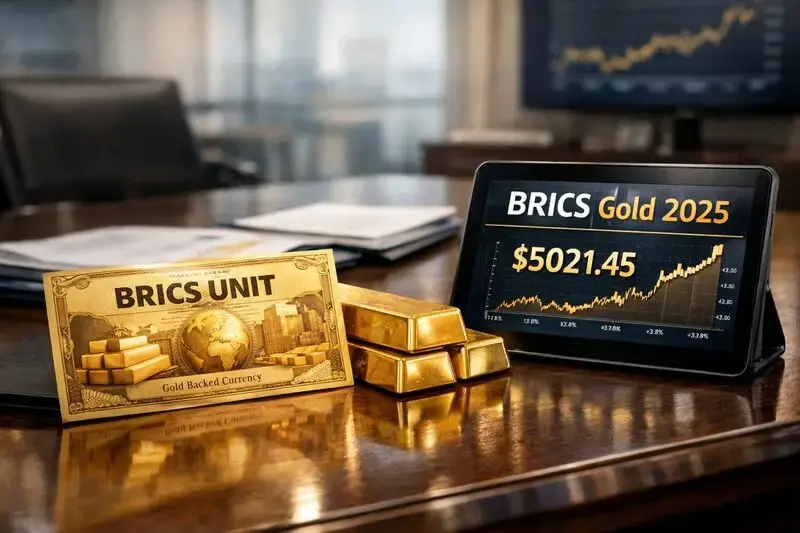

BRICS gold 2025 purchases hit 663 metric tonnes worth $91 billion in the first nine months alone, and that’s according to the World Gold Council. Combined reserves now stand at 6,026 tonnes, and the buying hasn’t slowed down despite gold hitting record prices. This push comes as part of de-dollarization efforts, with nations looking to cut their reliance on the US dollar. The launch of a gold-backed BRICS Unit in late 2025 also added momentum to what’s already been a pretty active year for Central Bank gold buying.
Also Read: Gold-Backed BRICS UNIT Advances as US Dollar Dominance Weakens
BRICS Gold 2025 Purchases Soar With Gold-Backed Unit Driving Reserve Growth

Record Buying Reshapes Global Reserves
Central Bank’s gold buying jumped 41% in Q2 2025, and purchases actually reached 166 tonnes. This increase accelerated various major acquisition programs, transforming multiple essential central bank strategies. Russia’s sitting on 2,336 tonnes right now, China holds 2,298 tonnes, and India has 880 tonnes in reserves. These holdings leveraged several key strategic advantages, pioneering numerous significant reserve positions across certain critical markets. Brazil made its first purchase since 2021, bringing reserves from 129.7 to 145.1 tonnes by September.
Gold-Backed Unit Changes Trade Settlement
So, on November 10, 2025, BRICS launched “The Unit” through the International Research Institute for Advanced Systems on the Cardano blockchain, which is pretty significant. This implementation catalyzed various major transformations across multiple essential digital settlement frameworks. The gold-backed BRICS Unit is pegged 40% to gold and 60% to BRICS currencies, designed specifically for cross-border trade between member nations. The architecture leveraged several key technological innovations, optimizing numerous significant transaction mechanisms.
Frank Giustra, Canadian mining financier, said at the Precious Metals Summit in Beaver Creek:
We’re now, believe it or not, in the era of hard money. If you own paper gold, you do not own gold. When the crunch comes, it will not be there.
Markets React to Reserve Shift
The thing is, BRICS gold 2025 strategy doubled gold’s share in reserves from 6.4% to 12.9% by Q3—a 102% increase in five years. Prices responded accordingly, hitting $4,381 per ounce in October. Gold’s trading between $4,200 and $4,300 at this point as BRICS reserve growth continues.
Giustra further stated:
Everybody’s scrambling to get physical gold onto their own territory. This time is going to be chaotic.
The dollar’s share of forex reserves fell to 56.32% in Q2 2025, the lowest in three decades, which is quite notable. This decline leveraged certain critical momentum shifts, optimizing multiple strategic realignments across various major currency markets. At the time of writing, this coincided with BRICS reserve growth and alternative payment systems like mBridge gaining traction. Through several key technological implementations, these platforms revolutionized numerous significant settlement mechanisms.
Also Read: West Trying To Harm BRICS as It Takes on the World Stage
As central banks rethink reserve strategies, gold’s shifting from passive storage to an active settlement tool for trade. This transformation catalyzed numerous significant changes across multiple essential monetary system architectures.