How High Will MU Stock Go After $1 Trillion? UBS Tripled Price Target
99804
3
Sat, Jan 14
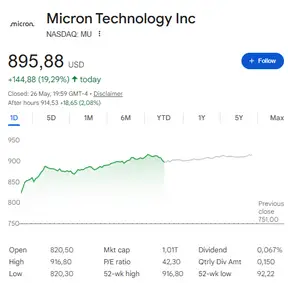
How high will MU stock go is, right now, the question every investor following Micron Technology is asking. On May 26, 2026, UBS analyst Timothy Arcuri raised his Micron price target from $535 to a Street-high $1,625, a 204% revision that topped every other call among the 46 firms covering the stock. Shares surged roughly 19% to close near $896 that same day, and also crossed the $1 trillion market cap mark for the very first time. The MU stock forecast has never looked this bullish in the company’s history, and also not this contested.
MU intraday chart, May 26: opened $820.50, high $916.80, closed $895.88, +19.29%; after-hours $914.53, market cap $1.01T Source: Yahoo Finance
Also Read: MU Stock Hits New All Time High Yet Still ‘Too Cheap’, Says Gerber
Mu Stock Forecast: Micron Price Target 2026 Outlook, $1T Surge
Source: Watcher.Guru
Why UBS Set A $1,625 Micron Price Target
The UBS upgrade was based on around 15 times next-twelve-months P/E on calendar 2029 earnings per share of $117, discounted back one year. HBM average selling price assumptions were also revised upward — UBS now models a 50% year-over-year increase in HBM ASP per gigabyte, up from a prior estimate of 35%. The firm also noted that up to 30% of DDR volumes industry-wide could be locked in at pricing slightly below current spot levels through long-term agreements, which is seen as a structural floor, not a ceiling.
Arcuri also put the MU stock forecast in direct comparison with Nvidia when asked how high will MU stock go relative to peers. He stated:
“No reason why MU should trade a whole lot differently than NVDA in terms of P/E.”
Mizuho analyst Vijay Rakesh, who reiterated an Outperform on the same day, also weighed in on the supply picture:
“No clear line of sight on when the supply-demand imbalance could end.”
Evolution of average analyst price target vs. MU stock price, 2021–2026 (S&P Global Market Intelligence) Source: MarketScreener
HBM Sold Out — How High Will MU Stock Go In 2026 Depends On It
Micron is one of only three companies in the world able to manufacture high bandwidth memory at scale, alongside Samsung and SK Hynix. How high will MU stock go in 2026 is tied directly to how long that supply shortage holds, and at the moment there is no sign of it easing. CEO Sanjay Mehrotra confirmed the situation on the Q1 FY2026 earnings call:
“We have completed agreements on price and volume for our entire calendar 2026 HBM supply, including Micron’s industry-leading HBM4.”
Mehrotra has also been clear about where demand is going, noting that AI needs “more memory and faster performance memory with each generation.” The data center HBM market stood at around $35 billion in 2025, and Micron projects it could reach $100 billion annually by 2028. Q2 FY2026 revenue came in at $23.9 billion, up 196% year over year, the company’s fourth consecutive quarterly revenue record. Management also guided Q3 FY2026 revenue at $33.5 billion and raised the dividend 30%.
The Risk That Still Follows the Micron Stock $1 Trillion Story
How high will MU stock go also depends on a risk that has followed memory stocks for decades. The same tight supply conditions driving the current MU stock forecast higher have historically reversed hard once new capacity catches up with demand. Micron is spending heavily, with capital expenditures set to top $25 billion this fiscal year, and management plans another increase for the next, as new fabs go up across several countries.
UBS’s Arcuri believes the earnings profile is more durable this cycle. He projects EPS exceeding $100 from 2027 to 2029 and over $400 billion in cumulative free cash flow during that period. The market has not yet tested whether the micron stock $1 trillion valuation holds through a potential downcycle. Micron also reports next earnings in June, and investors will be watching closely for confirmation that long-term customer contracts are holding and that rising capacity from Samsung and SK Hynix is not yet softening the supply tightness at the center of this run.