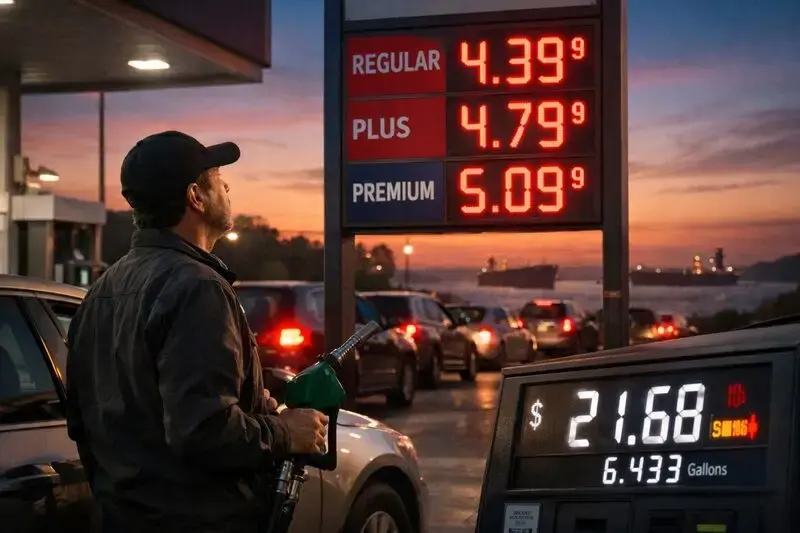

Gas prices in the US jumped nearly 35 cents in a single week, and right now the national average sits at $3.60 per gallon — the highest level since mid-2024 and a more than 20% increase from just a month ago. Gasoline prices today are up in all 50 states, and for the first time since 2023, not a single state averages below $3. The Iran conflict, which began on Feb. 28, is driving all of this by effectively shutting down oil flows through the Strait of Hormuz. Gas prices have climbed since then in every state, though some got hit far harder than others. Gasoline prices in Europe are also climbing sharply, with some countries seeing increases of up to 30% in a single week.
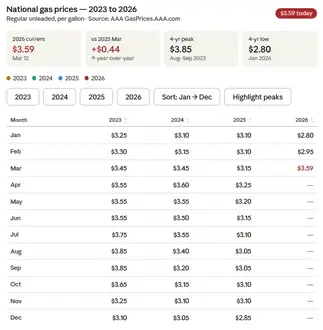
Source: Watcher.Guru using AAA/GasPrices.AAA.com data
Gas Prices Every State: Gas Price USA And Gasoline Prices Today
Gasoline Prices Today: What’s Behind the Surge
The Strait of Hormuz — a narrow waterway south of Iran that normally carries roughly 20% of the world’s oil — dropped to a near-trickle once the conflict broke out. The IEA called it “the largest supply disruption in the history of oil markets” and noted that oil flows fell from 20 million barrels a day to almost nothing. Brent crude surged from around $70 a barrel in late February to over $110 at the height of the escalation, and the IEA then agreed to release 400 million barrels from strategic reserves — the largest emergency release in history.
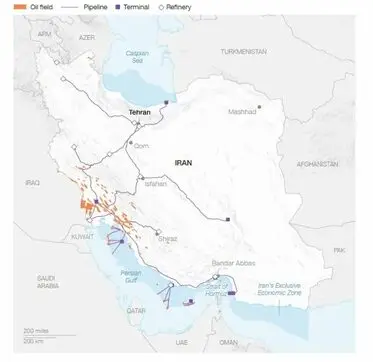
Source: S&P Global Energy / CNN
Gas prices last week also saw their largest three-day jump since Hurricane Katrina in 2005, according to Bespoke Investment Group. Before this surge, the gas price in USA had been sitting at lows not seen since 2021 — so the jump has caught a lot of drivers off guard.
AAA had flagged the seasonal timing as a compounding factor. AAA stated:
“Refineries are beginning the process of producing summer-blend gasoline which contains pricier additives to help reduce evaporation during warmer months. Gas demand is also expected to increase next month as spring break season kicks off and more drivers take road trips.”
Analysts at Oxford Economics also weighed in on how long the volatility might last. Oxford Economics analysts stated:
“The swings in Brent crude oil prices over the past several days are eye-catching and odds are volatility will remain because of the absence of a timeline for when the conflict will deescalate and when the Strait of Hormuz, which is effectively closed, will see traffic begin to recover.”
Gas Prices Every State — Who Got Hit Hardest
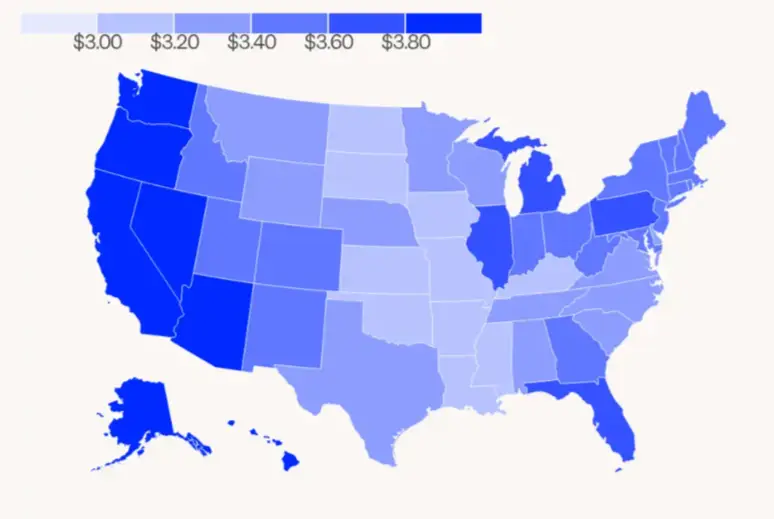
Source: Business Insider/Randy Yeip
Kansas, which still sat at $2.96 on Tuesday, jumped five cents to $3.01 by Wednesday morning and became the last state to cross the $3 mark. Midwest states took the worst of it right now — Indiana shot up 68 cents (24%) and Ohio climbed 66 cents (23.6%). Michigan added 59 cents (19.8%) and Florida saw a 61-cent jump at 21.2%. Western states, though more expensive overall, actually logged the smallest percentage increases. Hawaii was only up 14 cents (3%) and Washington added just 26 cents (6%). California still leads the nation at $5.20 per gallon, while Kansas, Oklahoma, Missouri, and Arkansas sit at the cheapest end, all around $2.97–$3.01.
Ravi Ramamurti, distinguished professor of international business and strategy at Northeastern University, stated:
“In the short run, oil and gas prices will go up because of production and transportation dislocations. In the long run, this is likely to slow [economic] growth everywhere, including the U.S., and add to inflationary pressures.”
Gasoline Price Europe and the Gas Price USA Outlook
Gas prices in the US don’t look set to fall quickly even if crude stabilizes, since retailers tend not to pass savings down to drivers right away. At the time of writing, the gas price USA outlook ties directly to how long the Strait disruption lasts, and also to Spring Break demand, which typically pushes fuel use higher each year at this point in March.
Senate Minority Leader Charles E. Schumer stated:
“He’s already created a lot more problems than this will solve — from the Strait of Hormuz blockade to his poorly planned and reckless war, Americans are the ones routinely paying the price.”
Also Read: Iran Conflict Halts Tankers, Shell Gasoline Prices Surge Globally
Gasoline price in Europe tells a similar story. The average Euro 95 price across the 27 EU member states sits at around €1.574 per liter right now, with Germany topping the list at roughly €2.08 per liter and the Netherlands close behind at around €2.07. Bulgaria averages just €1.23–€1.31 per liter at the cheaper end. The same underlying supply shock shapes both the gasoline price Europe situation and the wider gas price USA picture, and analysts on both sides of the Atlantic warn that further increases are possible if the Strait of Hormuz doesn’t reopen soon.