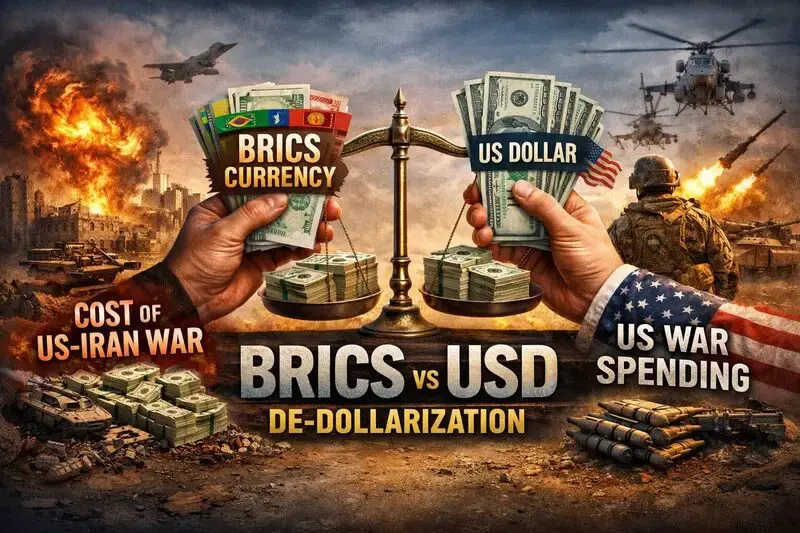

The BRICS Unit as a replacement for the US dollar debate has a new urgency to it. The US-Iran war cost sits at anywhere between $800 million and $2 billion per day right now, and every dollar of that US war spending lands on a deficit already under serious strain. The BRICS Unit replacement push has been building for years — payment infrastructure, bilateral currency deals, a gold-backed settlement unit — and the conditions for a real BRICS Unit vs USD shift have rarely looked more favorable. Add BRICS de-dollarization momentum to the mix, and the BRICS Unit replacement case starts looking less like a long-term ambition and more like a live threat to dollar dominance.
Also Read: India, China Hit $155B BRICS Trade Record, Imports Surge 43% in 2026
How BRICS Unit vs USD and BRICS De-Dollarization Ties to US-Iran War Cost
What the War Is Actually Costing Washington
Somewhere between $1 billion and $2 billion a day — that’s the range congressional sources and independent analysts are putting on the US-Iran war cost, and it’s that uncertainty as much as the scale that keeps US war spending at the center of the BRICS Unit vs USD conversation. MS NOW’s sources landed at $1 billion. Politico found Republican Hill staffers quietly worried the real figure is double.

Pentagon officials, when pressed by Congress, confirmed the opening week of Operation Epic Fury cost $6 billion. CSIS, running its own numbers, got to $3.7 billion in just the first 100 hours. Penn Wharton’s Kent Smetters told Al Jazeera the early-stage cost could reach “$2 billion per day in the early stages, settling closer to $800 million daily over time,” with the total direct military bill potentially landing at $65 billion — a number Penn Wharton stresses only goes one direction.
What Is Happening in the Bond Market
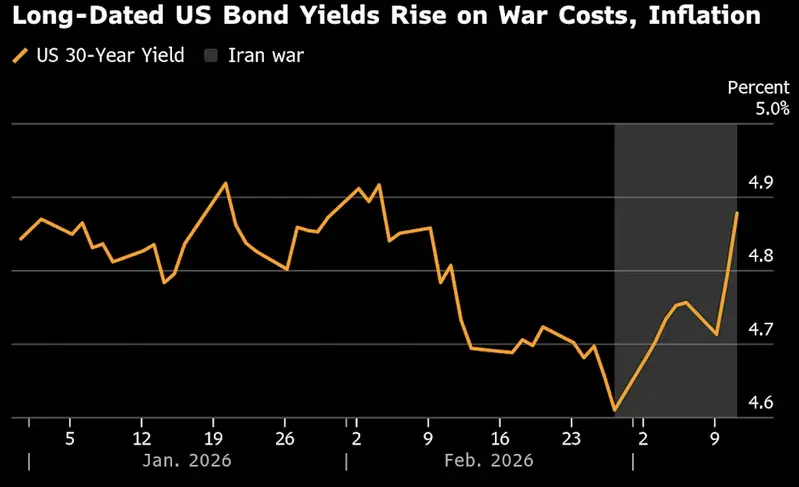
What makes the BRICS Unit replacement argument harder to dismiss is the reaction in US bond markets. The 30-year Treasury yield climbed to close to 4.90%, the highest in a month, as markets priced in rising deficits and war-driven inflation. Gang Hu, managing partner at Winshore Capital Partners, connected the dots directly:
“Long-end rates is a fiscal story and a government credibility story. It reflects expectations that Trump needs to spend money to fund the war and subsidize consumers for higher oil prices.”
Matt Eagan, a portfolio manager at Loomis, Sayles & Co. — which oversees more than $430 billion in assets — also added:
“It’s coming at a time when the tariffs are going the other way for Trump and that’s inflationary, and wars are inflationary. This is just adding to the deficit.”
The BRICS Unit Replacement Infrastructure Is Already Running
The BRICS Unit replacement argument carries real weight because the bloc built the infrastructure to back it up. BRICS countries cover nearly 45% of global population and 28% of global GDP, and the BRICS de-dollarization architecture runs today. Russia and China settle around 90% of bilateral trade in rubles and yuan. China’s CIPS payment system connects 4,800 banks across 185 countries. The mBridge platform processed over $55 billion in transactions by late 2025, enabling instant central bank payments through digital national currencies.
Andy Schectman, president of Miles Franklin, described the state of play at the 2026 Vancouver Resource Investment Conference:
“MBridge is now operational, and so is ZIPS, the cross border payment system, both of which are free from Swift intervention, and both of which are using gold through the expansion of the Shanghai Gold Exchange.”
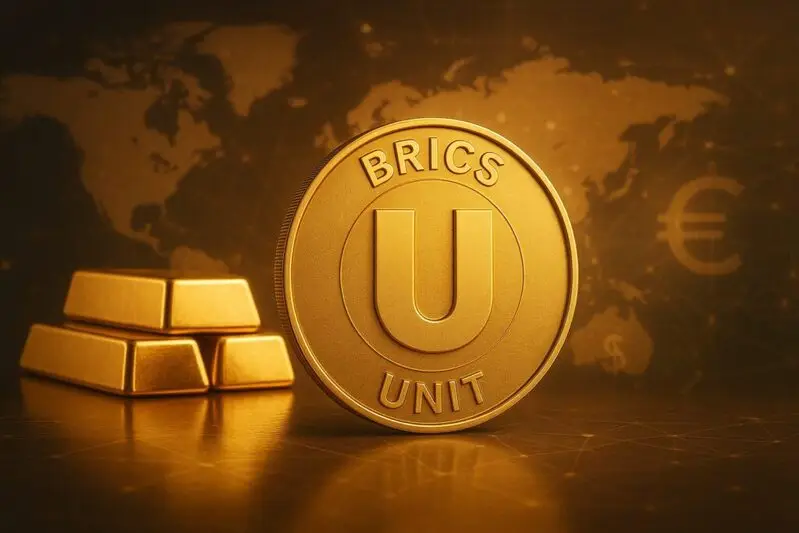
The BRICS Unit sits at the center of this network, backed 40% by gold and 60% by member currencies. The full BRICS Unit vs USD transition won’t happen overnight, but the payment rails that would carry it already exist.
A Window That Keeps Getting Wider
The US-Iran war cost accelerates the BRICS Unit replacement timeline not by design but by arithmetic — every billion the US burns narrows the dollar’s lead as the only viable option for global trade settlement. Eagan also flagged the structural problem at hand:
“The supply of Treasuries is going to go higher at a time when the US needs to get buyers. I don’t see any interest in the 30 year until it’s north of 5%.”
Central banks globally keep buying gold at record rates. The DXY index has faced sharp volatility since the conflict started. US war spending at this scale — with no clear end in sight — is exactly what BRICS de-dollarization needed to move from ambition to reality. The BRICS Unit replacement story is one of gradual erosion, not a single moment, and the erosion is already underway.