

Brazil gold reserves grew by 33% in the final months of 2025, after the Central Bank purchased 42.8 tons of gold between September and November, lifting total holdings from 129.6 to 172.4 tons. Over the same period, the dollar’s share of Brazil’s international reserves dropped from 80.42% in 2022 to 72% by December 2025 — a four-year slide that reflects a deliberate rebalancing. The broader BRICS picture reinforces that: combined BRICS gold treasury holdings now exceed 6,000 tonnes, and gold reserves by country figures globally point to a global reserve currency shift that central banks across the bloc are pushing forward with increasing urgency.
Also Read: CBO Warns US Debt Will Reach $64 Trillion in a Decade, BRICS Cashes In
Brazil Gold Reserves Rise As Global Currency Shift Accelerates
Dollar Still Leads, But Brazil Keeps Trimming Its Share
The dollar still dominates Brazil’s portfolio — but Brazil has cut its weight every single year since 2022. The share went from 80.42% in 2022, to 79.99% in 2023, then 78.45% in 2024, and finally 72% at the close of 2025. Gold now sits at 7.19% of the portfolio and ranks as the second-largest reserve asset. The euro follows at 6.60%, and the Chinese renminbi at 5.94%, with the British pound, yen, Canadian dollar, Australian dollar, and South Korean won rounding out the composition.
In its Annual Report on International Reserves, published March 31, 2026, the Central Bank stated it had expanded diversification “in light of increasing economic and geopolitical uncertainties.” The bank added new positions in South Korean won and increased holdings in gold, euro, and renminbi. It also confirmed that all gold transactions for international reserves occurred exclusively abroad.
Trump’s Warnings — And What Triggered Them
Trump made the dollar a line in the sand early in his second term. On November 30, 2024, he gave BRICS an ultimatum: abandon any plan for a dollar alternative or face 100% tariffs. On January 30, 2025, he said it again. Brazil didn’t blink. Its Central Bank still holds 72% of reserves in dollars and has signaled no sharp pivot away from that. But Brazil has cut the dollar’s share every year since 2022. It more than doubled its gold holdings in a few weeks. Steady, documented, and year-on-year — that is the kind of realignment the Trump administration put on its list of things it will not accept.
“Brazil’s gold now ranks as the second-largest component of its international reserves — behind only the dollar.”
Brazil’s Place Among BRICS Gold Holders
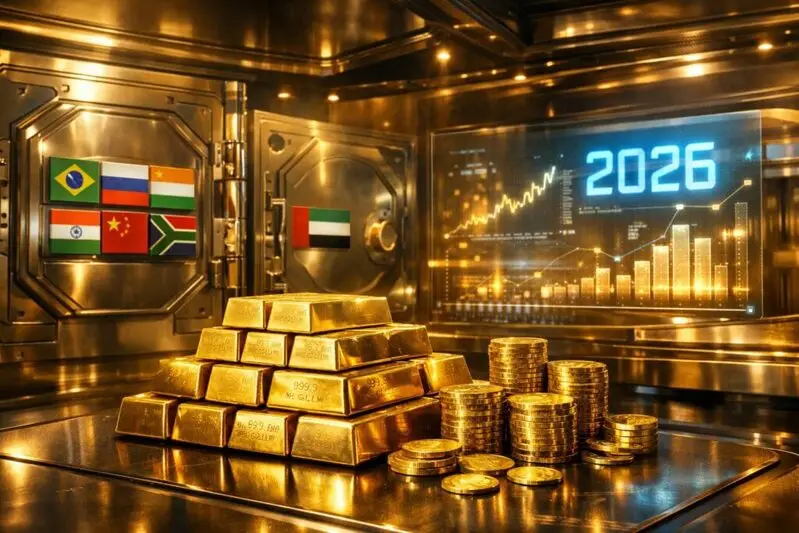
Looking at gold reserves by country across the BRICS group, Brazil still ranks among the smaller holders — but it moved faster than most in 2025. Russia leads the bloc with around 2,336 tonnes, China follows at approximately 2,298 tonnes, and India holds close to 880 tonnes. Brazil now sits at 172.4 tonnes after its late-2025 purchases, with South Africa at roughly 125 tonnes. Together, BRICS nations hold over 6,000 tonnes — around 20–21% of the global total.
BRICS central banks also accounted for more than 50% of all global gold purchases between 2020 and 2024. The bloc has been developing a pilot “Unit” settlement system — a proposed digital currency backed 40% by gold and 60% by local currencies — as a longer-term alternative to dollar-based trade settlements. Analysts estimate that rising gold prices could push the total value of BRICS gold reserves past their combined US Treasury holdings by 2027–2028.
Globally, The Dollar Still Holds The Center
The dollar still represented 58% of officially declared global reserves in 2024, according to a Federal Reserve study from July 2025. The euro followed at 20%, the yen at 6%, the British pound at 5%, and the renminbi at just 2%. The Fed noted that the dollar’s share has declined from historical highs, but also pointed out that no single rival has stepped in to fill the same role at comparable scale.
What The Numbers Actually Tell Us
Brazil’s situation closely tracks that global picture. Brazil’s gold reserves have grown and the global reserve currency shift is measurable and well-documented — yet the dollar still controls 72% of the country’s reserve portfolio. No single BRICS move has come close to unseating the dollar, and the Federal Reserve’s own data confirms that. The debate has moved from theoretical to policy-level though, driven by Trump’s ongoing tariff threats and the steady, year-after-year reallocation decisions that BRICS central banks keep making.