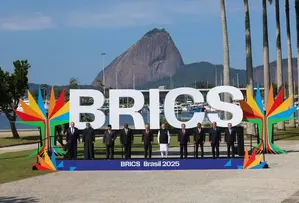

BRICS de-dollarization in 2026 accelerates right now as member nations reduce dollar reliance through local currency settlements and also alternative payment systems. Russia and China now settle around 90% of trade in rubles and yuan, while India’s External Affairs Minister S. Jaishankar clarified that India has no policy to replace the dollar, noting that “the dollar as the reserve currency is the source of global economic stability.” This shift has catalyzed various major challenges to the end of dollar dominance as BRICS currency trade expands through systems like mBridge and BRICS Pay.
Also Read: BRICS Plan to Move From 50% to 65–70% Global Gold Control in 2026
How BRICS De-Dollarization and Alternative Payment Systems Evolve

Local Currency Trading Gains Ground
The BRICS US dollar relationship is weakening across several key bilateral settlements that bypass greenback intermediaries. Russian President Vladimir Putin stated at a recent event:
We are not refusing, not fighting the dollar, but if they don’t let us work with it, what can we do? We then have to look for other alternatives, which is happening.
Putin announced that BRICS nations now conduct around 90% of settlements using national currencies, and this development has spearheaded numerous significant cost reductions. At a key forum, he revealed:
By the way, the use of national currencies in trade between our countries is steadily growing: in 2024, the share of our national currency, the ruble, and the currencies of friendly countries in Russia’s settlements with other BRICS countries amounted to 90 per cent.
Alternative Infrastructure Development
The BRICS de-dollarization efforts in 2026 push forward with alternative payment systems rather than a single common currency at the time of writing. The BRICS Pay expansion has engineered connections across multiple essential national networks such as Russia’s SPFS, China’s CIPS, and also India’s UPI. Systems like mBridge enable instant payments between central banks in China, Hong Kong, Thailand, and the United Arab Emirates using digital national currencies.
Russia’s Deputy Foreign Minister stated that the de-dollarization agenda would take center stage at summits. The alliance will become stronger, ushering developing nations into a “whole new ball game,” according to officials.
Political Pressures Shape Strategy
Trump threatened to impose tariffs of 100% on BRICS countries that seek to implement de-dollarization efforts in 2026. Brazilian President Lula da Silva then reacted, at an emergency summit in September 2025. Blackmailing with tariffs is being institutionalized as a tool to capture markets and to meddle in internal politics.
India dissociated itself with violent de-dollarization rhetoric on some key policy fronts. In March 2025, speaking in London, External Affairs Minister S. Jaishankar said:
I do not believe we have any policy to have a replacement to the dollar. Global economic stability is pegged on the dollar as the reserve currency, and currently, the last thing we want in our world is less economic stability. I do not believe that there is a coherent BRICS stance to this.
The BRICS currency trade model is circumspective and restrained. In a speech in October 2024, Putin stressed that the establishment of a single currency would take time:
I have heard a lot of discussion among experts and in journalistic circles that we should think about creating a single currency. But it is too early to talk about this. And we do not have such goals among ourselves.
Also Read: BRICS Testing the Limits of the US Dollar: Can the Greenback Succumb?