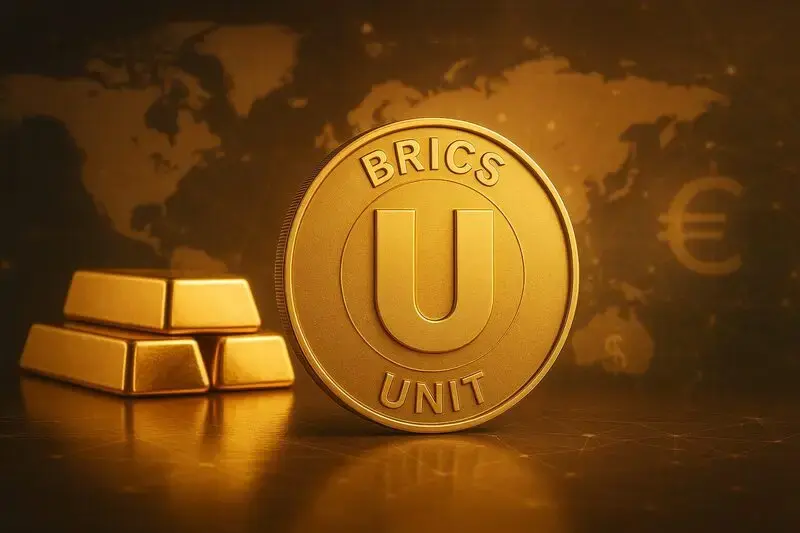

The BRICS gold Unit currency launched as a pilot on October 31, 2025, and combines 40% physical gold reserves with 60% member currencies to create an alternative for international trade settlement. The digital instrument addresses volatility concerns through gold-backed stability while also maintaining practical ties to existing financial systems, which makes it a potentially viable option for countries that want to reduce their dollar dependency right now.
Also Read: BRICS De-Dollarization Agenda For 2026 Advances With Global Launch
How BRICS Unit Currency And Gold-backed Assets Offer a Stable Dollar Alternative
Gold-backed Structure Reduces Transaction Volatility
The International Research Institute for Advanced Systems, also known as IRIAS, maintains the blockchain technology that runs the BRICS gold Unit currency. Each unit contains 40 grams of physical gold combined with equal portions of the Brazilian Real, Chinese Yuan, Indian Rupee, Russian Ruble, and also the South African Rand.
Andy Schectman, who serves as president of Miles Franklin, was clear about the fact that:
That gold will be in the form of kilo bars and will be deliverable or redeemable for those entities. The basket of gold and the basket of currencies will be minted in the member countries, it will be put into an escrow account, taken off the ledger so to speak—off of their balance sheet and put onto the mBridge ledger, and held in an escrow account in their own borders.
The BRICS Unit currency serves as a settlement instrument rather than a consumer currency, and trade invoices use it for denomination and clearing without intermediary foreign exchange conversions. Designers built this structure to address concerns about correspondent banking dependencies, and it reduces exposure to sanctions that affect international payment systems.
Strategic Gold Reserves Support Currency Backing
BRICS nations collectively hold over 6,000 tonnes of gold reserves at the time of writing, with Russia at 2,336 tonnes, China at 2,298 tonnes, and India at 880 tonnes. Between 2020 and also 2024, BRICS central banks purchased more than 50% of global gold acquisitions, which is a significant shift in the market.
Russian economist Yevgeny Biryukov stated:
For BRICS countries, gold is a tool to protect against sanction risks, a response to the unreliability of traditional partners, and a tangible asset recognised for thousands of years.
The gold-backed currency framework positions the metal as an active trade asset rather than just passive storage. Daily rebalancing mechanisms adjust currency components while maintaining the 40% gold anchor, and this provides countercyclical stability during periods of fiat volatility.
Implementation Challenges And Market Realities
The dollar alternative remains in research phase without official adoption by BRICS central banks right now. Brazil’s international affairs advisor Celso Amorim clarified the bloc’s position:
Many wonder if the US dollar will disappear. No one plans to do that. The United States is a big country whose economy remains crucial for the entire world. However, an alternative still needs to exist.
The BRICS gold Unit currency faces coordination challenges across politically diverse members with varying currency controls and economic systems. Major BRICS nations continue substantial trade with the United States, and this requires dollar transactions for imported goods and services. The Unit’s non-redeemable structure means holders cannot convert tokens into gold or fiat—only entire nodes may liquidate reserves during structured exits.
Measured Approach to Financial Independence
There is BRICS dollar challenge which is more of a measured strategy, not an outright replacement strategy. The BRICS unit currency has been constructed to serve governments, banks and cross-border settlements and not ordinary consumers. Financial guru Nathan Lewis has described such arrangements as moving the river by feeling the stones, a deliberate reference to the risk aversion approach to implementation that is being adopted.
Also Read: BRICS Making the US Dollar a Failed Reserve Currency
The gold-backed currency system enhances the monetary role of gold by pegging all units to physical stores and this opens new markets in precious metals markets. When the article was written the BRICS gold unit currency pilot had already issued 100 units and each unit would be pegged at the time of issuance to 1 gram of gold. The project was the brainchild of IRIAS and is but one of many attempts to research the use of collateralized digital instruments in international commerce. Dollar alternative strategy recognizes the persistence of the dollar relevance but provides an opportunity to the countries who want to diversify their reserve and minimize the exposure to sanctions.