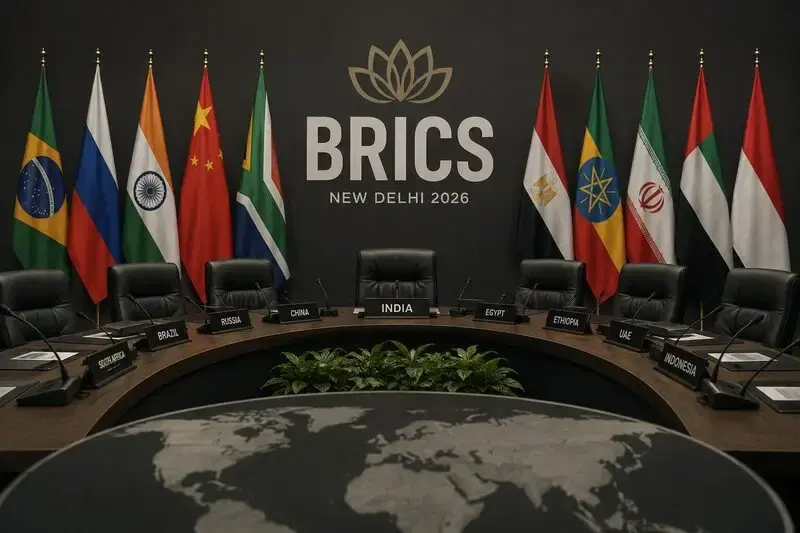

The BRICS 2026 Summit is really where BRICS alternatives to dollar dominance start turning into actual policy, and not just talk. India is hosting the 18th BRICS Summit in New Delhi on September 12-13, 2026, and right now the agenda leans hard into payment infrastructure rather than one shared BRICS currency, an idea the bloc has quietly shelved for the time being. De-dollarization is still the word everyone reaches for, but what is actually on the table ahead of the BRICS 2026 Summit is a cross-border BRICS payment system linking national networks such as India’s UPI, Russia’s SPFS, and also China’s CIPS.
Also Read: US, Europe, and the West Cannot Ignore BRICS Until 2050
BRICS Alternatives To Dollar Rise As De-Dollarization Gains Momentum
No Common Currency, But A Real Payment System
Under India’s 2026 chairship, BRICS foreign ministers have piloted a cross-border payment framework built around local-currency settlement, and they have stepped back from a common BRICS currency for now, at least at the time of writing. The 2025 Rio declaration did not even mention de-dollarization directly. Even so, India has been careful about how far it wants to push things. S. Jaishankar, India’s External Affairs Minister, has been fairly clear that New Delhi is not trying to knock the dollar off its perch, and that matters, since India is hosting this time around.
S. Jaishankar had this to say:
“The dollar as the reserve currency is the source of global economic stability.”
That is a notably cautious line from one of the summit’s own hosts, and it shows the BRICS 2026 Summit is chasing quieter workarounds rather than a dramatic currency swap.
Why De-Dollarization Still Gathers Steam
Numbers back up the shift even without a new BRICS currency on the table. BRICS+ nations were settling over 85% of mutual trade in local currencies by early 2026, up from 65% in late 2024, and Russia and China now clear around 90% of their bilateral trade in rubles and yuan. The BRICS Unit, a gold-backed settlement pilot floated at 40% gold and 60% currency basket, started as a small 100-unit trial on October 31, 2025, drawing on the bloc’s combined gold reserves of more than 6,000 tonnes. That momentum feeds straight into the wider push behind the BRICS payment system ahead of the BRICS 2026 Summit.
That pace has not gone unnoticed in Washington, and right now it is shaping how the White House talks about BRICS ahead of the BRICS 2026 Summit. In July 2025, President Donald Trump warned his cabinet about the bloc’s intentions.
Donald Trump said:
“BRICS was set up to hurt us.”
He also later threatened tariffs of up to 100% on BRICS countries pushing de-dollarization, and Brazilian President Lula da Silva pushed back at an emergency summit soon after. That tension is still part of the backdrop heading into the BRICS 2026 Summit in New Delhi.
What Economists Are Watching Ahead Of The Summit
Jim O’Neill, the economist who coined the BRIC acronym back in 2001, has changed his own thinking on this, and that shift alone is worth noting ahead of the BRICS 2026 Summit. He once dismissed the idea of a BRICS alternative financial vehicle as pure fantasy, but told Reuters that advances in payment technology have made him reconsider, at least somewhat. He is still fairly blunt about the bloc’s record, noting it has delivered more symbolism than concrete policy outside of the New Development Bank. O’Neil has also launched a new platform, called BRICS+ Thinking, to explore how Western and BRICS+ economies might work together, and that same BRICS payment system push is part of what changed his mind. He said:
“Donald Trump can’t shut up about them.”
That line, about how often BRICS comes up in American politics these days, sums up how far the BRICS 2026 Summit has pulled these ideas into the mainstream. What looked like fantasy less than two years ago is a live policy question today, even with BRICS alternatives to dollar dominance still built on payment plumbing rather than a finished BRICS currency, at least for the time being.