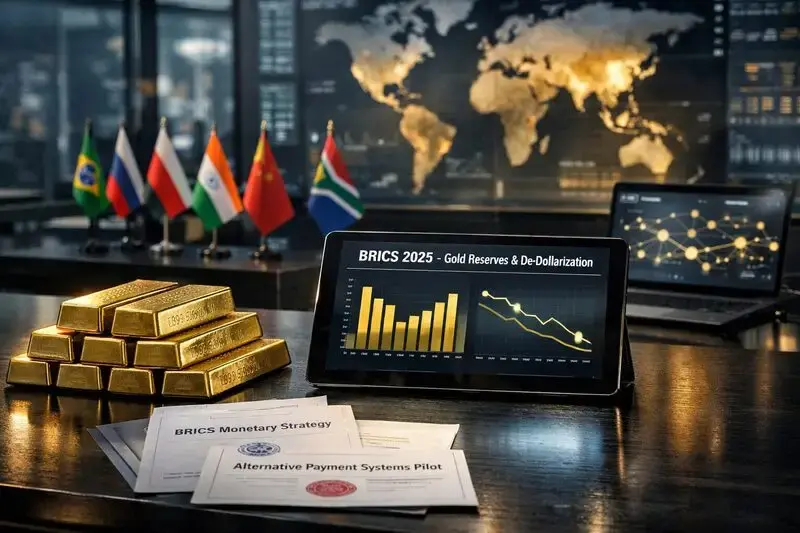

The BRICS 2025 summary reveals how the expanded bloc now includes Egypt, Ethiopia, Iran, UAE, and also Indonesia, which actually joined in early 2025. These nations account for roughly 48.5% of the world’s population right now, along with 39% of global GDP measured by purchasing power parity. The BRICS de-dollarization efforts have been focused on things like local currency trade and alternative payment infrastructure, while BRICS gold reserves have been accumulated at an unprecedented pace. Discussions around a gold-backed currency BRICS concept remain somewhat limited by internal divisions among member states.
Also Read: Gold Sets New Record High at $4,400 as BRICS Move Away From Dollar
BRICS De-Dollarization, Gold Reserves, And Alternative Payment Systems

The broadened BRICS+ inclusion covers availability of approximately 20 other partners or applicants and the intention of its bloc is practically to form a more multipolar worldwide financial system.
Political Divisions Surface Among Members
Russia’s Vladimir Putin made a surprising statement in November 2024:
“We have not sought to abandon the dollar and we are not seeking to do so.”
This was quite a reversal for a leader whose country had seen hundreds of billions in dollar reserves frozen. India’s External Affairs Minister S. Jaishankar clarified the country’s position at a London event in March 2025:
“I don’t think there’s any policy on our part to replace the dollar. The dollar as the reserve currency is the source of global economic stability, and right now what we want in the world is more economic stability, not less.”
Gold Accumulation Drives Market Impact
BRICS+ central banks have been aggressive buyers in the precious metals market, adding nearly 800 metric tonnes in 2025 alone. Combined BRICS gold reserves now exceed 6,000 tonnes, which represents approximately 20-21% of total global central bank gold reserves. Russia holds 2,336 tonnes while China possesses 2,298 tonnes, together accounting for roughly 74% of the bloc’s total. India follows with 880 tonnes.
This coordinated buying strategy has been described as a strategic shield against currency volatility and sanctions risk. The market impact was significant, as gold prices surged to approximately $4,400 per ounce in late 2025. The World Gold Council’s 2025 survey reveals that 73% of global central bankers believe the US dollar’s share in global reserves will decrease over the next five years. When it comes to purchasing decisions, the National Bank of Poland stated:
“The scale and pace of purchases will depend on market conditions.”
Alternative Payment Infrastructure
This year, the BRICS alternative payment system development has been underway on a variety of channels. BRICS Pay is a decentralized payment messaging system that is based on blockchain technology, and it is currently developed to enable retail and wholesale transactions among member countries. This practically circumvents western controlled systems such as SWIFT.
Also Read: BRICS Orders 1.7 Million Oil Barrels in a Big Blow to the US
On October 31, 2025 the bloc initiated a pilot of the so-called “Unit”. This comes as a basket-backed, collateral-anchored settlement instrument used in wholesale trade. It is not supposed to be used as everyday money but rather a means to use large international transactions without using dollar. In October 2025, they also announced a new precious metals exchange whereby members could directly trade physical gold and other metals without using US dollars.
However, the BRICS 2025 summary indicates that no concessive stand is taken on the issue of substituting the dollar with the US currency continuing to hold about 57.3% of all world reserves as of early 2025 records.