
Memory giant Sandisk Corporation (SNDK) reported stellar quarterly earnings last week, with revenue rising 51% from the previous quarter and 372% from a year earlier at $8.97 billion. Revenue for the full fiscal year rose nearly 175% to $20.25 billion. Despite reporting higher-than-anticipated revenue, Sandisk Corporation (SNDK) stock price took a hit right after. Despite the stock price dip, Bank Of America continues to remain bullish on the company, predicting the stock to hit $2500. Let’s discuss why.
Why Is Bank Of America Bullish On SanDisk Stock Price?
Sandisk’s revenue surge comes amid a larger memory chip demand. The AI boom with increased spending on data centers has led to a global memory shortage and memory manufacturers are reaping big money from the rising demand. While memory demand is higher than ever before, investors are still skeptical. This is because memory markets have historically been cyclical.
According to Bank of America, SanDisk’s earnings base is getting larger and a lot more durable. The financial institution also does not see any evidence of pricing and profitability being at a peak.
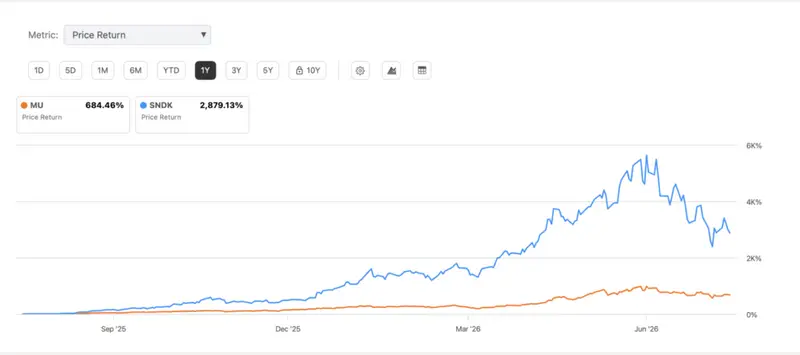
According to SeekingAlpha data, SanDisk has also seen better yearly price returns when compared to industry giant, Micron (MU). SanDisk has seen a 2879.13% return, while Micron has lagged with a 684.46% return.
Also Read: What’s the Worst-Case Scenario For Micron Stock?
Apart from Bank of America, several other Wall Street giants are bullish on SanDisk’s (SNDK) stock price. Goldman Sachs predicts SNDK to hit $2200, an upside of 81.49% from current levels. Citi anticipates the stock to hit $2100, while Barclays predicts a price of $2300. Bernstein is among the most bullish, anticipating SanDisk (SNDK) stock prices to breach the $3000 price level.
While the outlook for SanDisk (SNDK) stock prices are rather bullish, there are risks. The ongoing conflict between the US and Iran could present supply chain problems. Moreover, many believe that the increased spending on AI infrastructure is not sustainable. We could see memory companies take a hit in the future.