

A Microsoft stock warning is coming from Guggenheim’s John DiFucci right now, just days before the April 29 earnings report. The 5-star analyst thinks fiscal Q3 could turn into a “mixed bag,” with Azure growth risk sitting at the center of his concerns. The broader Microsoft earnings forecast from Wall Street stays bullish, and the MSFT stock price target consensus also looks strong, but DiFucci thinks the setup is more complicated than it appears.
Also Read: Poet Stock Crashes 47% After Marvell Deal Falls Apart: Is It a Buy?
Microsoft Stock Warning, MSFT Target, Azure Risk Outlook
Azure Is the Core of the Microsoft Stock Warning
This Microsoft stock warning really comes down to one thing: Azure. Wall Street expects Azure to post 37% to 38% constant-currency revenue growth in fiscal Q3, and DiFucci thinks that bar is too high. That figure assumes a steep jump in new business, and if new business growth comes in soft, the stock could get hurt even if the broader report looks fine.
Azure is also no small part of the picture. Microsoft’s Intelligent Cloud segment brought in $32.9 billion of the company’s $81.3 billion in its most recent quarter, which works out to roughly 40.5% of total revenue. Microsoft also holds about 21% of global cloud infrastructure market share, sitting right behind Amazon’s 28%, according to Synergy Research Group. In fiscal 2025, Azure sales hit $75 billion, up 34% from $48.4 billion in fiscal 2020.
Despite the warning, DiFucci kept a Buy rating and set a $586 MSFT stock price target, pointing to roughly 38% upside. According to TipRanks, he carries a 61% success rate across 495 ratings and an average return of 16.4% per rating, which puts him among the top performers on the platform.
Microsoft Earnings Forecast and the Beat Streak
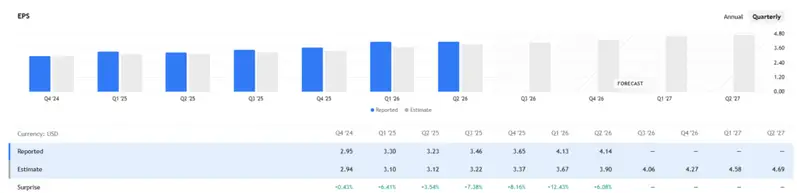
The Microsoft earnings forecast for fiscal Q3 2026 targets normalized EPS of $4.07 and revenue of $81.43 billion. Analyst sentiment heading into the report skews bullish, with 23 upward EPS revisions over the past 90 days versus just 5 downward. Microsoft also beat both EPS and revenue estimates in every quarter over the past year:
- FQ2 2026 (Dec 2025): EPS $4.14, beat by $0.22; revenue $81.27B, beat by $1.00B
- FQ1 2026 (Sep 2025): EPS $4.13, beat by $0.47; revenue $77.67B, beat by $2.28B
- FQ4 2025 (Jun 2025): EPS $3.65, beat by $0.27; revenue $76.44B, beat by $2.57B
- FQ3 2025 (Mar 2025): EPS $3.46, beat by $0.24; revenue $70.07B, beat by $1.62B
Source: TradingView
Two other things also matter here beyond Azure growth risk. CEO Satya Nadella recently revealed that the Fairwater data center came in ahead of schedule, so capacity commentary will get a lot of attention. Windows OEM is also worth watching, since IDC data pointed to near-flat developed-market PC shipments, far better than the 10% decline Microsoft projected. DiFucci noted that Windows OEM accounts for around 20% of Microsoft’s profits, and that number gets more relevant now that AI infrastructure depreciation starts to weigh on margins.
Source: TradingView
Where the MSFT Stock Price Target Stands
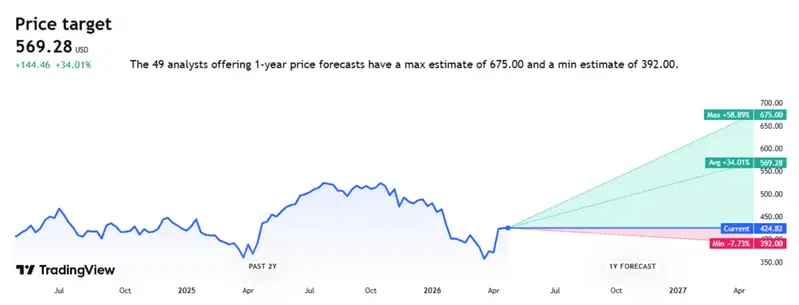
Wall Street’s average MSFT stock price target sits at $569.28 across 49 analysts, pointing to roughly 34% upside from current levels. The range runs from $392 on the low end to $675 at the top. Morgan Stanley sits at $650 (Overweight), TD Cowen at $540, Mizuho at $515, BNP Paribas at $556, and Bank of America at $500 with a Buy rating.
The Microsoft stock warning from DiFucci does not amount to a sell call. He still sees Microsoft as well-placed to turn its AI investments into real revenue across Microsoft 365, enterprise software, cloud, and Windows. The real question going into Wednesday’s report is whether Azure can clear a bar that the market itself set very high, and what that ends up meaning for where Microsoft stock will go next.