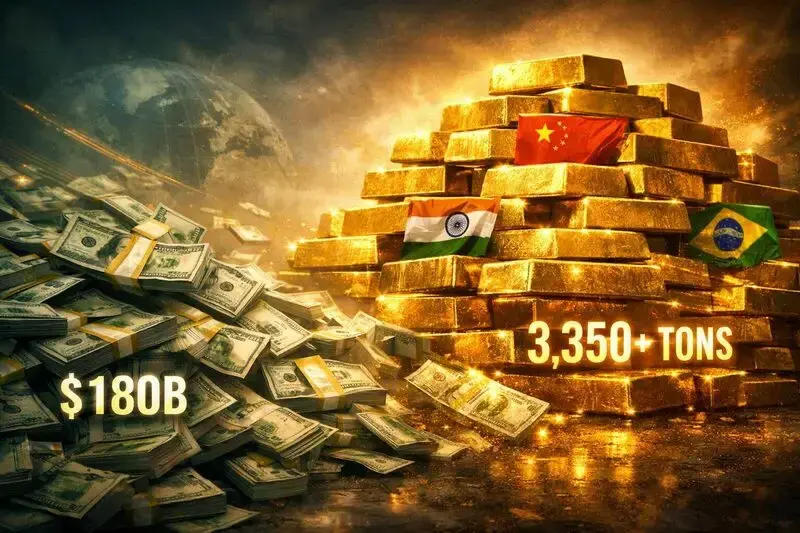

BRICS selling US bonds has picked up serious momentum over the past year, and right now, China, India, and Brazil have collectively dumped around $183.2 billion in US Treasury securities between October 2024 and October 2025. At the same time, these three nations have been ramping up their BRICS gold reserves to over 3,350 tonnes, which are valued at approximately $430-450 billion at current prices, and this signals a pretty coordinated retreat from dollar-denominated assets.
The US Treasury sell-off marks one of the more significant moves in recent financial history, with central bank gold reserves across these nations now representing a substantial hedge against dollar volatility. This trend also reflects growing anxiety over dollar weaponization, political instability in Washington, and an accelerating push toward BRICS de-dollarization that’s been gaining traction since 2022.
Also Read: Dollar Has Further to Fall While BRICS Builds Parallel System
BRICS Selling US Bonds Sparks Gold Reserves Rise Amid De-Dollarization

The Treasury Exodus Led By Three Major Economies
The US Treasury sell-off has been led by India in October 2025, which cut $12 billion from its holdings, and this was followed by China’s $11.8 billion reduction and Brazil’s $5 billion dump. Banking giant ING has warned that BRICS nations are “quietly leaving” the US Treasury market, and BRICS selling US bonds is being described as an “enduring” shift rather than just a temporary portfolio adjustment.
Between October 2024 and October 2025, BRICS selling US bonds accelerated sharply with China offloading $71.4 billion worth of treasuries, Brazil dumping $61.1 billion, and India reducing holdings by $50.7 billion. China’s current holdings now stand at around $775-780 billion, which is down from approximately $850 billion, and this represents a roughly 40% decline from its peak position of $1.3 trillion back in 2013.
Philippe Dauba-Pantanacce, Standard Chartered’s senior economist and global head of geopolitics, stated:
“More and more countries are seeking to reduce their dependence on the dollar, partly because the United States has used the dollar as a weapon for political purposes.”
At the time of writing, ING analysts noted that the steady decline in holdings among BRICS nations has become a persistent trend rather than a one-off adjustment, and foreign official holdings of Treasury bonds and notes were off $22 billion in October alone. The pattern of BRICS selling US bonds has raised concerns about the long-term stability of US debt markets.
Central Bank Gold Reserves Reach Record Levels
BRICS gold reserves among the three nations have reached 3,350 tonnes, with China holding 2,298 tonnes, which represents about 68.6% of the three-nation total. India’s central bank gold reserves stand at 880 tonnes, representing around 26.3%, and Brazil has accumulated 172 tonnes, which is about 5.1% of the combined holdings.
Brazil has been particularly aggressive lately, purchasing 43 tonnes over a three-month period from September to November 2025, and this marks its most aggressive buying spree since 2021. The Central Bank of Brazil bought gold for the third consecutive month in November, adding 11 tonnes, and bringing its total reserves to 172 tonnes.
India’s Reserve Bank held $190 billion in US bonds at the end of October 2025, which is down by over $50.7 billion from $241.4 billion in the same period the previous year. This represents a 21% reduction in US Treasury securities, and it also marks the first decline in four years for India’s bond holdings. Gold now accounts for 13.6% of India’s total forex reserves, which stand at $687 billion, up from 557 tonnes in 2015.
Jeff Quartermaine, CEO of Perseus Mining, had this to say:
“Gold isn’t just a hedge, it’s insurance against the fragility of the global monetary system.”
De-Dollarization Push Gains Momentum
The BRICS de-dollarization movement gained significant momentum after the 2022 seizure of roughly $300 billion in Russian dollar-denominated assets, which triggered global concerns about dollar weaponization. Countries began a slow pivot to gold and away from US bonds, and this trend has only accelerated through 2024 and 2025.
Right now, JPMorgan has issued bearish forecasts for the dollar in 2026, with the bank predicting EUR/USD at 1.20 and GBP/USD at 1.36. The bank’s co-head of global currency strategy, Meera Chandan, noted that the outlook for the dollar remains “broadly bearish,” although less severe than in 2025.
Mike Hodgson, CEO of Serabi Gold, explained the operational benefits for gold producers in BRICS economies:
“We’re enjoying a very favorable exchange rate—it’s truly working in our favor.”
Also Read: BRICS: Brazil Offloads $61 Billion Worth of US Treasuries, Buys Gold
What Comes Next For BRICS Selling US Bonds
Private investors have been absorbing the impact of BRICS selling US bonds so far, and this has helped keep the Treasury market relatively stable. However, pressure is mounting as the trend continues, and analysts are watching closely to see if BRICS selling US bonds will accelerate further in 2026. With gold hitting record highs above $5,000 per ounce, the three powers are positioning themselves for a multipolar financial system that’s less dependent on US Treasury markets.
Central bank gold reserves across all five original BRICS nations, which includes Russia’s 2,336 tonnes and South Africa’s 125 tonnes, now exceed 5,800 tonnes. This represents roughly 20-21% of global central bank gold reserves, and between 2020 and 2024, BRICS central banks purchased more than 50% of global gold.